Marine renewable energy is often framed as a future opportunity.
For island states like Mauritius, it is not optional.
It is structural.
This Ocean Week, I’ll be joining a panel discussion on Marine Renewable Energy, and I would like to say:
Our main constraint is not capital.
It is not technology.
🏝️ It is land. ❌
When energy is viewed through that lens, a clear hierarchy emerges:
• Land‑based solar competes for scarce space and food security
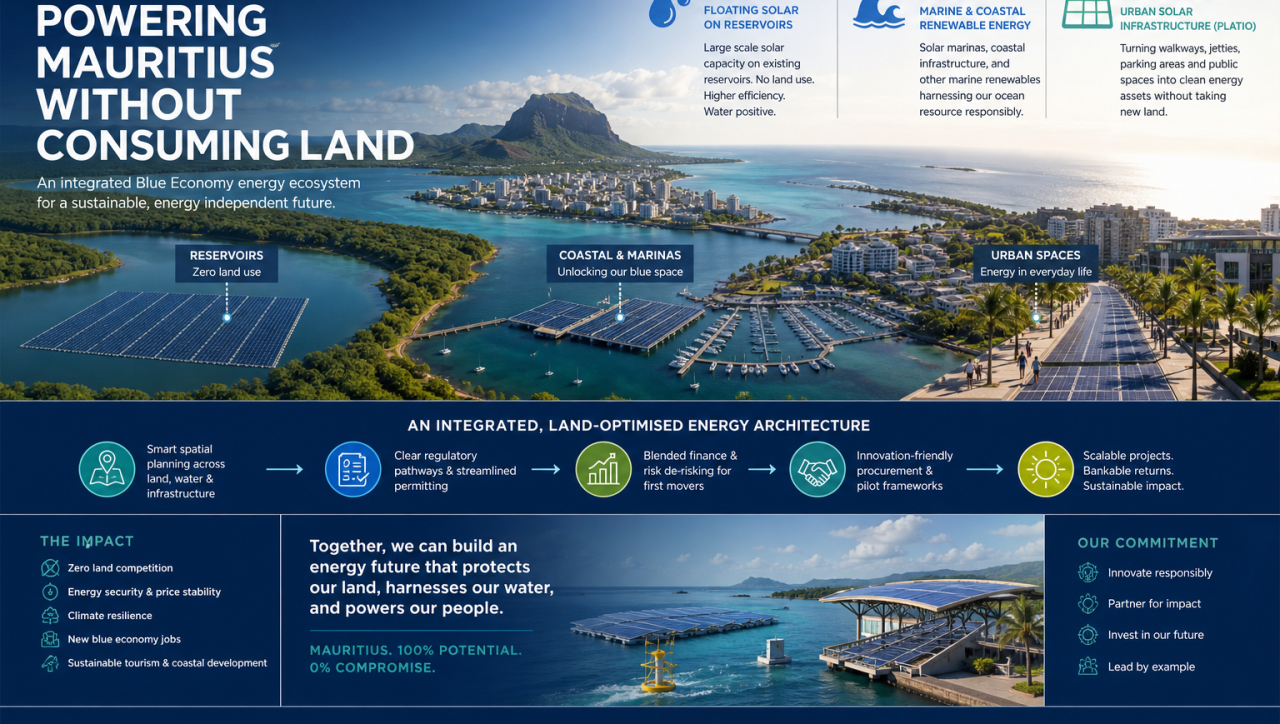
• Floating solar unlocks water surfaces with zero land impact
• Marine and coastal systems generate energy without competing for land at all
And crucially marine renewable energy is not just about solar.
For Mauritius, it is a portfolio:
🌊 Wave energy, leveraging consistent southern Indian Ocean swells
💨 Offshore wind, delivering scale without land consumption
🪸 Ocean Thermal Energy Conversion (OTEC), offering long‑term baseload potential in tropical waters
🌞 Alongside marine‑integrated solar on marinas, reservoirs and coastal infrastructure
Individually, each has limits.
Together, they change the system.
So the real question is not if marine renewables will happen. It is whether we create the conditions to scale them in time.
From hands‑on experience, four barriers stand out:
1️⃣ Regulatory invisibility
Marine energy sits between maritime, environmental, tourism and port authorities without a unified pathway.
This is not a technology issue. It is a coordination failure.
2️⃣ First‑mover financial risk
Marine‑integrated projects work – but they don’t fit traditional risk models yet.
Without precedents, early projects carry disproportionate risk.
3️⃣ The innovation penalty
New solutions are asked for references and frameworks that, by definition, do not yet exist.
Innovation is filtered out by the system that needs it most.
4️⃣ Missing system integration
Marine renewables cannot be planned in isolation.
They must sit alongside floating solar, urban infrastructure and selective ground‑mounted systems as one land‑water energy system.
The good news?
Unlocking marine renewable energy does not require subsidies. It requires:
✅ Regulatory clarity
✅ Risk‑sharing for first movers
✅ Innovation‑friendly public pilots
✅ Integrated land–water energy planning
Mauritius has a rare advantage:
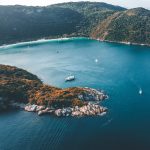
A constrained landmass, extensive marine and water surfaces, and a clear Blue Economy ambition.
If we align policy, finance and spatial planning, we can build a model for island energy independence without land trade‑offs.
The private sector is ready.
Now the enabling environment must move at the same speed.
Looking forward to the conversation this Ocean Week.